
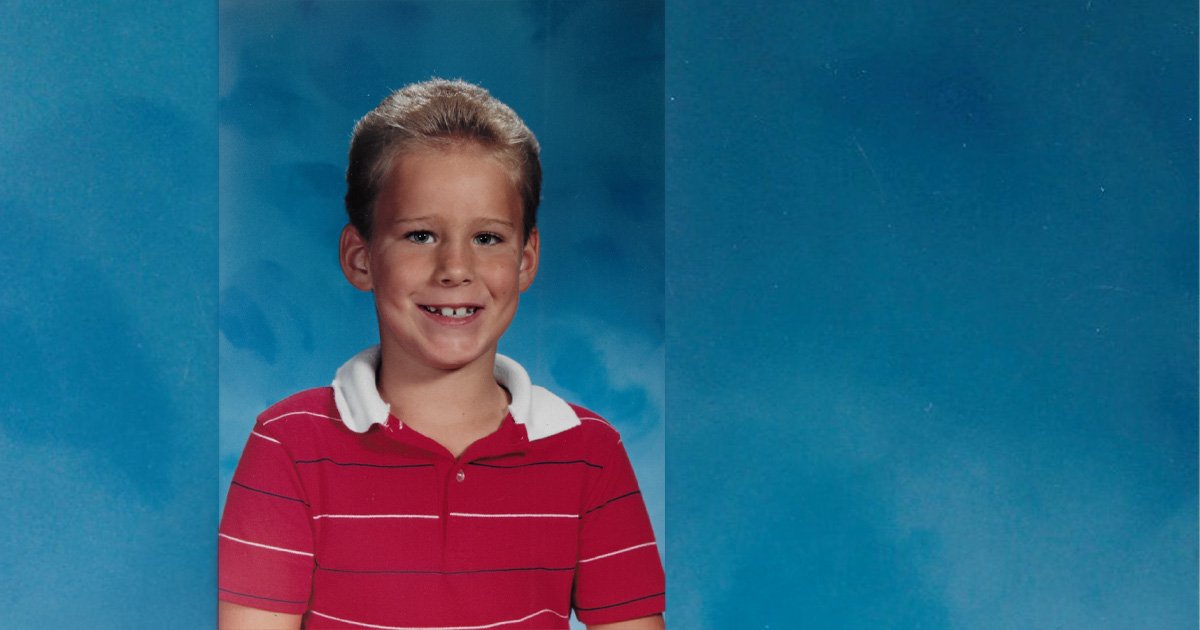
“Have you guys seen Jamie?”
Those are the words that would change my life forever.
I was seven years old. Almost eight. Second grade.
My dad had just gotten home from a trip, and my brothers and I were outside showing him tricks on our scooters when my mom came around the corner asking if we’d seen my little sister.
We hadn’t.
Jamie was two.
At that point, everybody split up to look for her. We checked around the house, the neighborhood, nearby yards. Somewhere in the middle of all of it, I heard a splash in our pool.
Not a big splash.
Not someone jumping in.
Just… a splash.
I remember hearing it and deciding it was probably a frog.
We lived in Florida. Frogs in the pool weren’t unusual. So I kept looking.
After a while, my older brother and I came back to the house for a drink of water, and we both had the same thought at the same time:
Check the pool.
We ran outside and saw her floating on top of the water.
I jumped in and pushed her toward the edge while my brother pulled her out. My parents came running. Someone called 911. She was taken to the hospital and remained in a coma for nine days before doctors determined she was brain dead.
Then they took her off life support.
For years afterward, I replayed that splash in my head.
Over and over. To this day I can still hear it.
Because in my mind, that sound had been her last attempt to stay above the water. And I’d heard it. I just didn’t understand what it was.
So I came to a conclusion that made perfect sense to a seven-year-old brain:
It was my fault.
I heard the splash.
I didn’t recognize it.
I didn’t save her.
Now everyone is devastated.
At seven years old, I obviously didn’t understand any of this consciously. I just knew that everyone was sad, and somehow I felt responsible.
And underneath all of that was another conclusion I don’t think I consciously realized I’d made until much later:
Never again.
Never again would I be the reason people felt pain if I could help it.
Looking back, I can trace a surprising number of my patterns back to that moment.
Not all of them. Human beings are more complicated than that. But enough of them that it’s hard to ignore.
For most of my life, I’ve experienced other people’s emotions as something I was responsible for managing.
If someone was upset, I must have done something wrong.
If someone was disappointed, I must have failed them somehow.
If there was tension in a room, I must not be doing enough to keep the peace.
Growing up, I was constantly praised for being “the peacemaker.”
At the time, that felt like a compliment.
And maybe part of it was.
But looking back, I think what people were often seeing was a kid who became extremely sensitive to tension, disappointment, conflict, and other people’s emotional states.
I got very good at reading rooms.
Very good at smoothing things over.
Very good at anticipating reactions before they happened.
Very good at trying to manage the emotional temperature around me.
I don’t even know how to fully explain the feeling except to say that it never felt optional. It felt moral.
Like if I were really good enough, attentive enough, thoughtful enough, then maybe I could prevent discomfort before it happened.
A few months ago, my therapist used the word codependency to describe some of these patterns, and honestly, at first I resisted it.
Mostly because the word itself sounded wrong to me.
I associated it with weakness or unhealthy attachment or people losing themselves in relationships. None of that felt like what I was experiencing.
But the more I sat with it, the more I started understanding what people actually mean by it: feeling responsible for other people’s emotional state. Trying to prevent discomfort before it happens. Managing tension, expectations, reactions, and moods as if they’re yours to carry.
And once I started recognizing the pattern, I began seeing it everywhere.
It’s a little like buying a car and suddenly noticing that exact model all over the road. The cars were always there. You just didn’t have a framework for noticing them before.
And the strange thing is that a lot of these moments seem to trace back to second grade.
The shoe story I wrote about previously happened around the same time.
Not because second grade is magically important, but because that seems to have been the age when I started forming quiet conclusions about myself and my responsibility to other people.
I think some people would probably call parts of this codependency. Maybe they’re right.
But I’m less interested in the label than in understanding the pattern itself.
Because kids experience something painful and start quietly drawing conclusions about themselves and the world.
And sometimes a child experiences tragedy, guilt, shame, or instability and quietly decides:
I need to be more careful.
I need to not create problems.
I need to make sure everyone is okay.
I need to manage the emotional temperature of the room.
Then they carry those rules into adulthood and mistake them for love, responsibility, or maturity.
Sometimes they even get rewarded for it.
I care deeply about people. I don’t think that’s wrong.
But I’m slowly learning that love and responsibility are not the same thing.
And that no matter how badly seven-year-old me wanted it to be true, I was never going to be able to protect everyone from pain.
Next: what this actually looks like in adulthood.


Wow! What a heavy burden you carried for so many years. You are light and goodness and kindness. I’m so sorry you had to go through this and I’m so proud of you for figuring it all out now! Beautifully written!
Thanks for the kind words! I’m grateful for your friendship.
Dear Justin,
You have written your feelings so well. Jamie’s passing is still a very painful time for your family. The what if’s haunting everyday. I am so sorry for your loss. It takes courage to share your thoughts and feelings you have carried with you for so long.
Even though we were so far away I still remember this difficult time and not being able to do anything but pray.
I have fond memories of you being easy going and thoughtful as a child. You sent a letter to Bryce when he was younger. ( I think we still have it😊)You have grown up to be a wonderful caring person. Thank you for sharing so I can know you even better. ❤️
You and Uncle Ken have always been such great friends and examples. Thank you.
Beautifully said. I wish I could hug 7 year old Justin & tell him it’s not his fault. Glad you’re working through it & making connections.
The part you shared about children drawing conclusions & creating rules based on misconceptions or misunderstanding yet getting praised for their behavior because outwardly it may come across as love or responsibility really resonated with me. I think it can be a result of positive experiences as well as negative. You’ve also helped me gain a new perspective of codependency. Thank you for sharing ❤️
Thank you for sharing this. It really resonated with me and touched me.